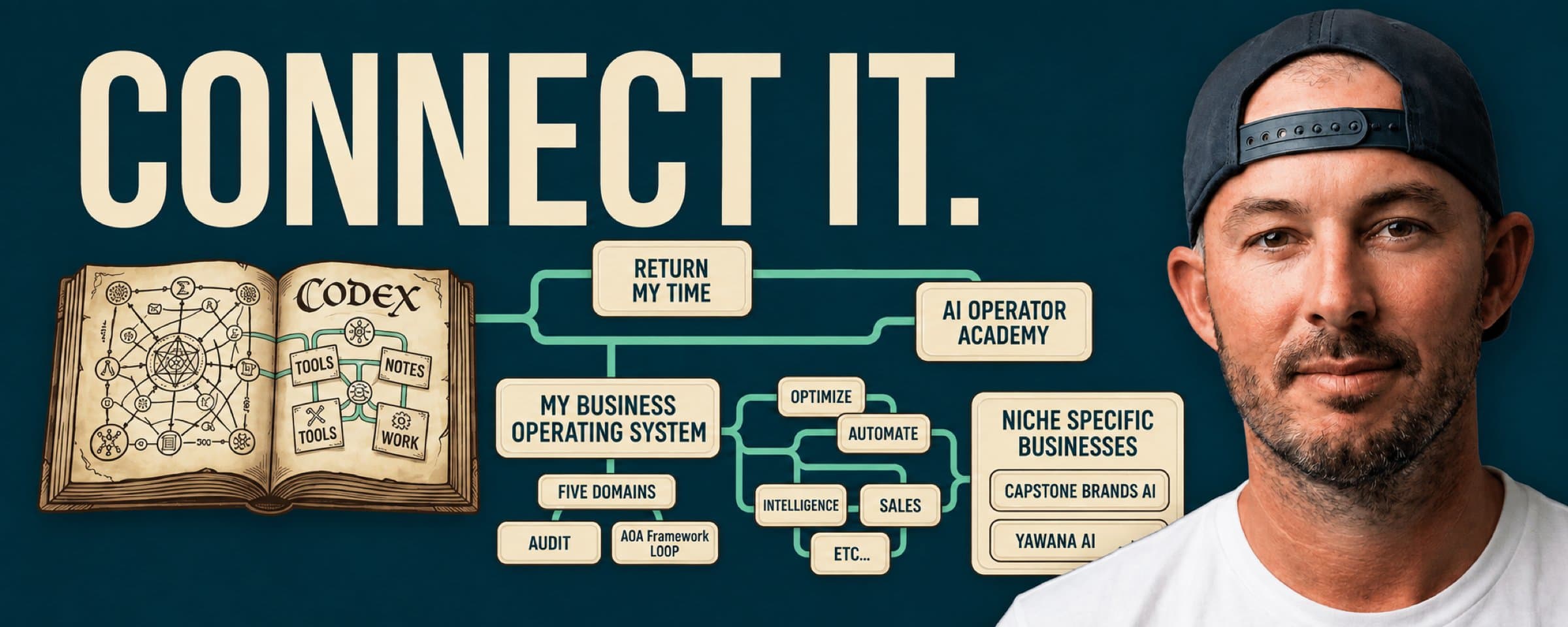
Most business owners don't need another AI tool. They need the tools, notes, and work they already have to connect.
In the first lesson of The AI Owner-Operator, I walk through a business operating model that helps you choose one useful next build. The goal is to look at a job in your business and understand its inputs, decisions, and output before you decide where AI belongs.
Start with a job that stalls, breaks, or depends on one person. Keep the scope small enough that you can inspect the result.
Choose the outcome before the tool
I look at three levers: effectiveness, efficiency, and quality. Does this help the business make money? Does it save time for the owner or team? Does it improve the customer experience?
Those questions give you a reason to work on a process. They also give you something to check after you change it. A new tool is useful when you can connect it to the job and the outcome you want.
Audit, optimize, automate
First, audit what happens today. Write down the information that comes in, the steps people take, the decisions they make, and the known failure points. Include the places where the work waits for someone.
Then optimize it. Remove steps that don't need to happen. Simplify the steps that remain. Make the instructions clear enough for someone else to follow.
Once you've done that, choose a bounded, repeatable part to automate. Keep a record of what went into it and what came out, including what went wrong. Use that feedback to improve the process.
This order gives you a way to decide what to build next and what to leave alone for now.
Give each part of the system a job
The operating model connects knowledge, work, decisions, and evidence. Its components have different responsibilities:
- A second brain or knowledge base holds the business context so each request can draw on the same information.
- Clean data gives the system trustworthy material to use.
- Skills turn standard operating procedures into reusable instructions for AI.
- Connectors move the right context between the tools that need it.
- Managed agents perform bounded work, with a named human responsible for the decision.
You can apply those components across marketing, sales, operations, finance, and intelligence. The diagram is a teaching model. Each proposed use case still needs its own inputs, instructions, and review.
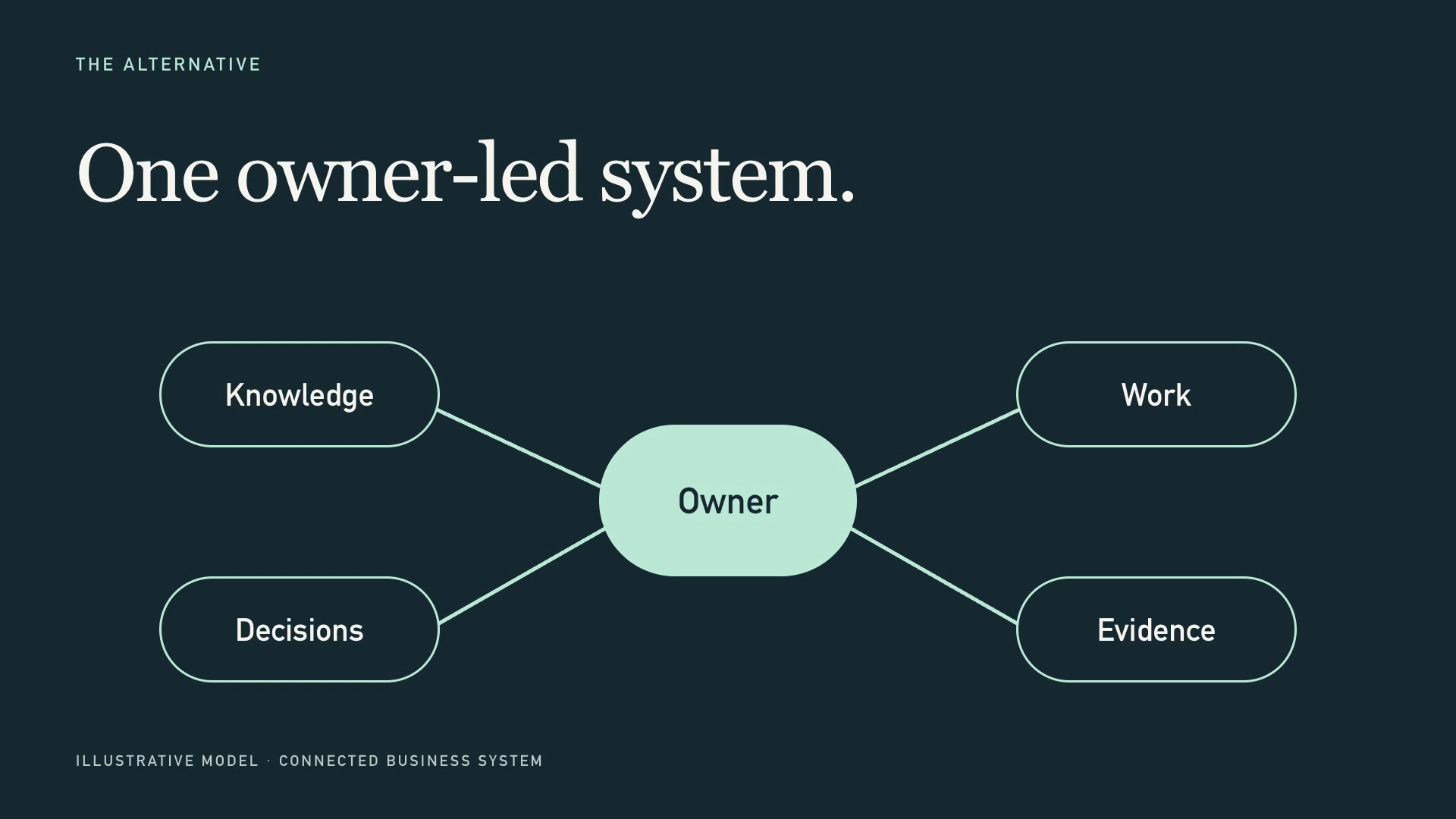
Illustrative owner-led system from Episode 1: knowledge, work, decisions, and evidence stay connected.
Keep the approval line visible
Write down where a human must approve, reject, or handle an escalation. If you cannot point to that line, the job is not ready to automate.
A fictional quote-request example makes this concrete. A coordinator receives a service request, checks the details against an approved price list, and prepares a draft quote for the owner.
The bounded AI task could be to prepare that internal draft and flag missing information. The owner reviews the scope and price before anything reaches the customer. Custom work, conflicting prices, and unclear scope go back to the owner. Sending quotes automatically stays outside this first build.
That example is included in the One-Job Builder companion worksheet. It illustrates how to define the task; it is not a claim about a customer deployment or measured result.
Write your next-build decision
Take one fragile job and answer these questions:
- What information does it need, and where does that information come from?
- What happens today, and where does the work fail or wait?
- What can you remove or simplify?
- What bounded task should AI perform, and what output should it produce?
- Who approves the output, and what must be rejected or escalated?
Then name the next build and the output you will inspect. For the quote example, that means an internal draft checked against the approved pricing source, with missing details surfaced for review.
The next lesson covers GitHub for business as a home for your business information and its history. For this lesson, start with one job inside one business. Tell me which job you chose and which part of defining it was unclear.
Episode 1: Choose one fragile job
Excerpt · 8:41–9:03. Audit the inputs, decisions, and failure points of one job.
Episode 1: Keep human approval visible
Excerpt · 9:24–9:45. Automate the bounded, repeatable part. Define where a human approves, rejects, or escalates.
Watch the full episode
Want to see how the pieces fit together? Watch Episode 1 on YouTube: Stop Collecting AI Tools. Build a Business System.
Pick one job in your business as you watch, then tell me in the YouTube comments what you want to build next.