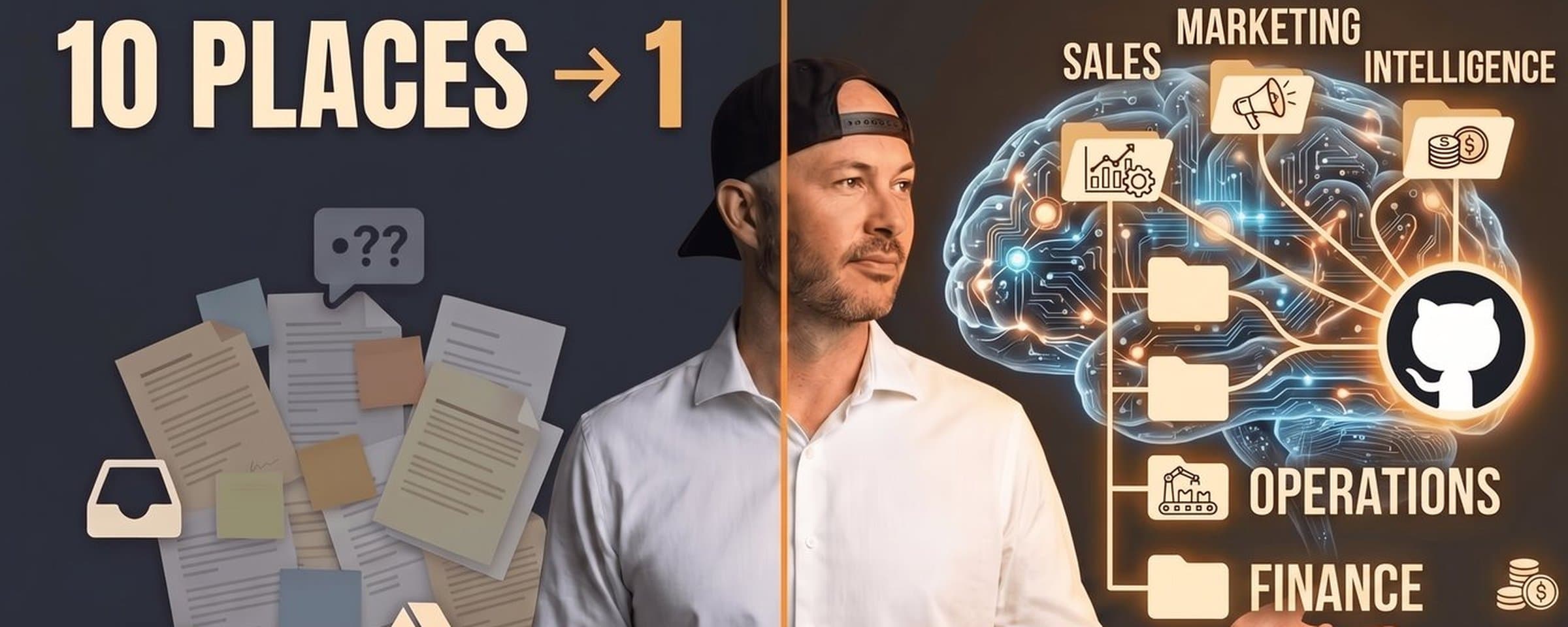
Every AI tool, agent, and new hire in your business starts from zero. Your SOPs and core knowledge live in ten places, nobody owns the current copy, and you explain the business again in every chat.
In the second lesson of The AI Owner-Operator, I set up a free, business-owned GitHub organization for Capstone Brands, my Amazon brand business, and show an AI tool answering a question from a file in that repository.
What GitHub is, for an owner
GitHub stores files and folders and keeps their history. You can go back to any snapshot and see who made a change, when they made it, and what changed. A knowledge base in its most primitive form is files and folders, which is why AI tools can read one directly.
My own portfolio runs from a GitHub-hosted second brain. The repository is the gold copy every tool reads from.
What goes in, what stays out
- Standard operating procedures. The way you actually do the work.
- Decisions. Who was in the room and what the circumstances were, so a quarterly review or annual planning session does not relitigate a settled question. When circumstances change, the log shows what the old decision rested on, and you can make a different one.
- Reference data. Price lists, vendor sheets, quotes. The proprietary information your decisions get made from.
Three things stay out: passwords, customer personal information, and bank statements. Anything you would not want a new hire to have on day one.
The business owns it
Set the knowledge base up at the organization level in GitHub, under the actual name of your business, with everything underneath that organization. You get role-based access control over who can reach it. The company's organization holds the data, with you as an owner, rather than a consultant's account or an office manager's Google Drive. When people change, the knowledge stays.
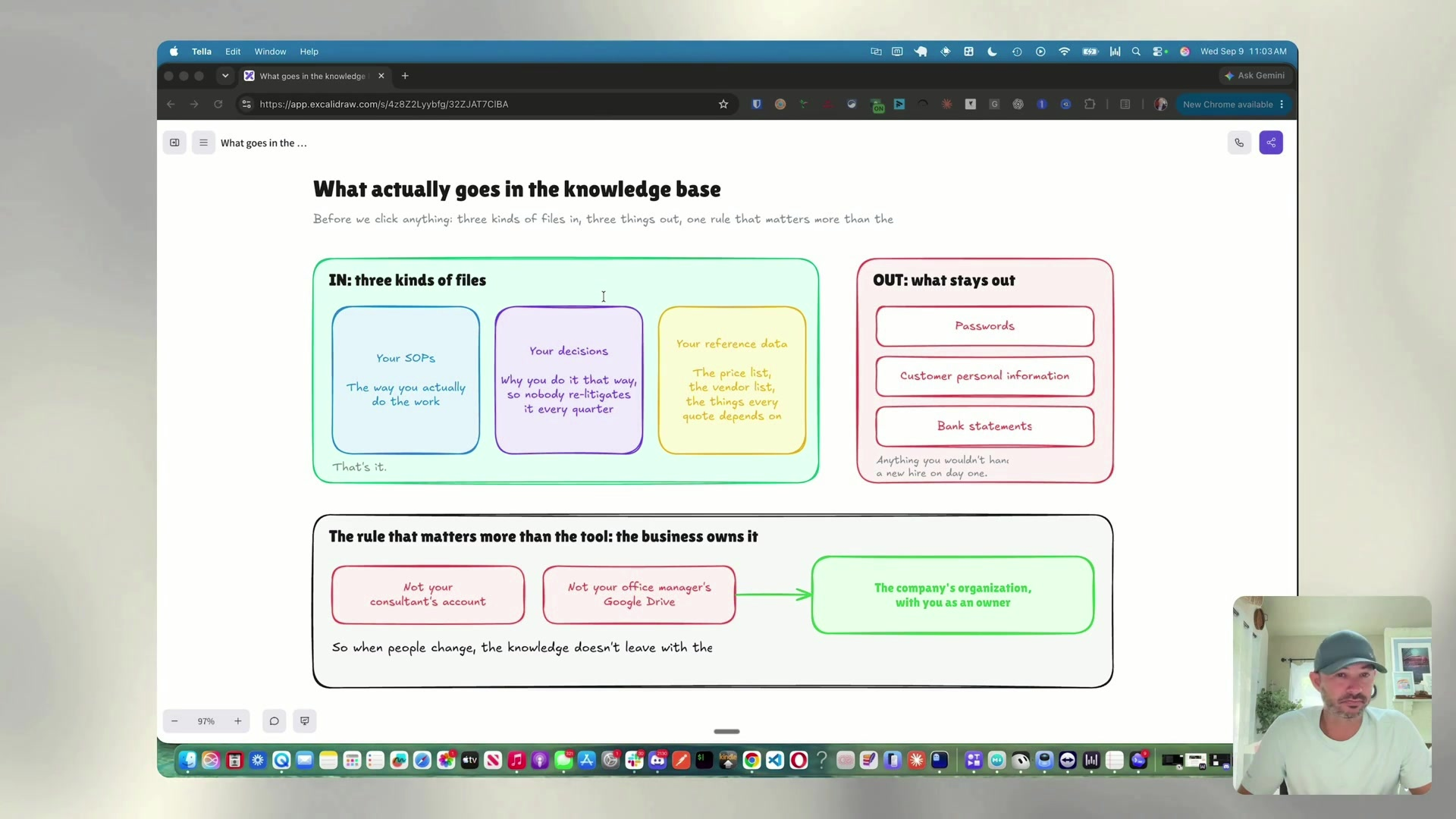
From Episode 2 at 3:05: three kinds of files in, three things out, and the business owns it.
Create the organization
- Go to github.com. Sign up with Google, Apple, or an email address if you are new, or sign in if you already have an account.
- Pick a plan for the organization. The free plan covers most of what a business needs to start.
- Choose "create a free organization." Name it after the business, give it a contact email, mark it as a business or institution, and accept the terms.
- Add team members, or skip this step and add them later.
The private repository for the knowledge base sits inside that organization. GitHub Desktop gives you a local copy on your machine without a terminal: paste the repository URL and click clone.
Give every procedure a home
The Capstone Brands repository has a top-level folder for each domain of the business, including sales, marketing, operations, intelligence, integrations, and finance. A new procedure goes into operations, under SOPs.
Each SOP follows the same format: an ID, a title, and its place in the structure, then the procedure itself. Say brand A makes widgets and you restock that product every 45 days. Interview yourself, or the person with the expertise, about how that restock decision gets made. Run the transcript back through the repository and the AI files the SOP where it belongs. You end up with a framework for any procedure or decision the business depends on.
Ask it one question
I opened the repository folder in the ChatGPT desktop app, working through Codex, and set the reasoning level low, because reading a file back does not need the most expensive setting. Use the right level of intelligence for the job.
The first instruction was git pull origin main. It means go to GitHub, grab the latest version of the gold copy, and bring it down to this machine.
Then I asked the real question: who is Capstone Brands' ideal customer profile?
About 30 seconds later it answered from the file. Brands generating at least $100,000 a month across all channels, with a focus on brands where we have a specialized advantage on Amazon. It cited the exact file it read, icp.md.
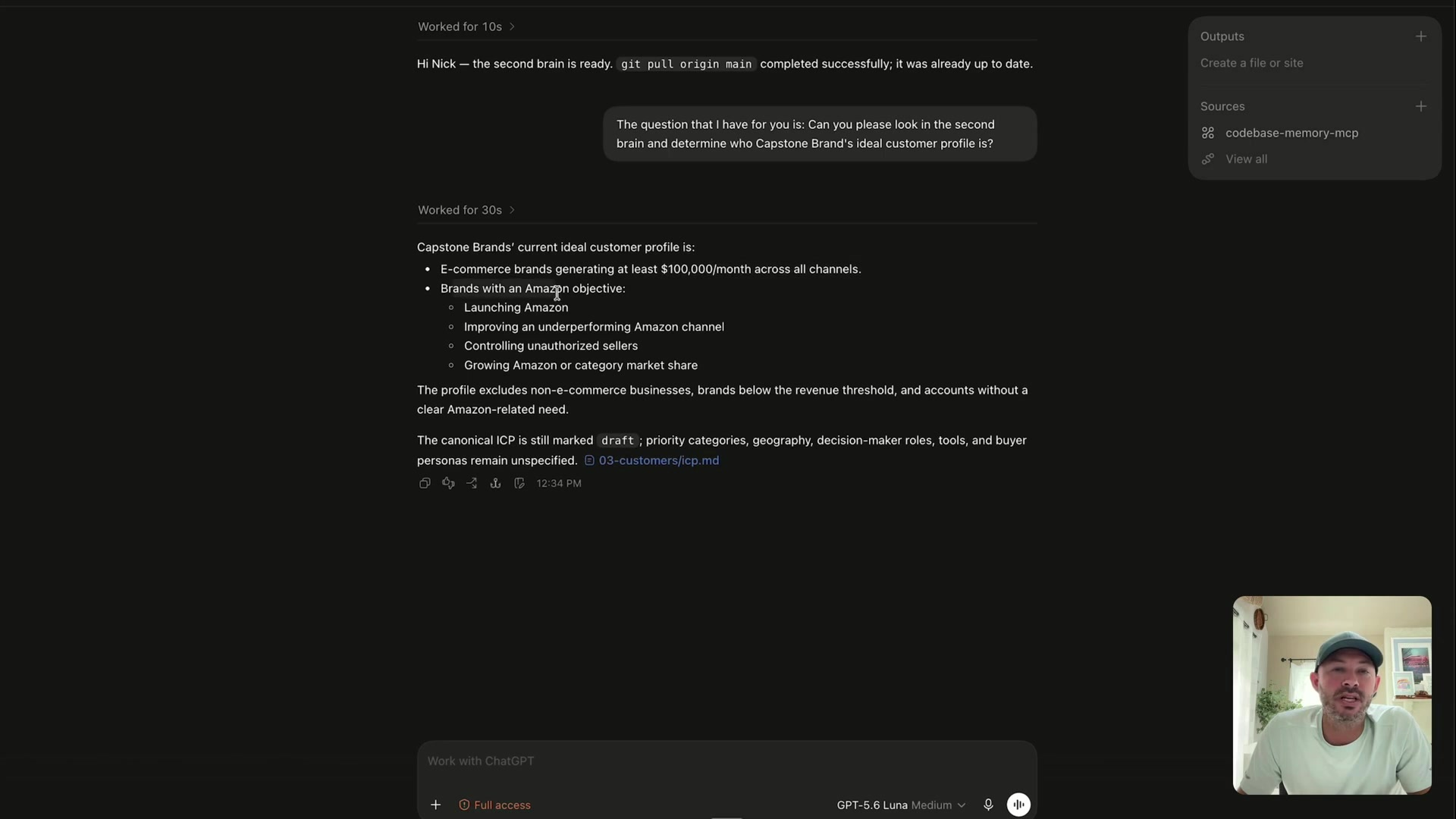
From Episode 2 at 10:05: the answer, and the file it came from.
Your first step this week
Create a GitHub organization for your business with a repository inside it. Put something real in it. An SOP, a decision log, or a price list is enough. Then point the AI tool you already pay for at it and ask one question, not ten. Make that one question work before you build on it.
A future episode covers connectors, distilling your business knowledge into clean data, and getting the rest of it into the second brain without turning it into a mess.
Episode 2: What stays out, and who owns it
Excerpt · 2:34–3:14. Passwords, customer personal information, and bank statements stay out. The business's organization owns the knowledge base.
Watch this excerpt on YouTube.
Episode 2: Ask it one question
Excerpt · 9:40–10:21. One question to the second brain, answered from the cited file.
Watch this excerpt on YouTube.
Watch the full episode
Watch Episode 2 on YouTube: The GitHub Trick That Makes AI Actually Know Your Business
The free setup guide is linked in the video description. If something was unclear, tell me in the comments.